Solar Market · · Updated · 9 min read
Net Metering vs Net Billing vs Gross Metering in India: A Practical Guide for 2026
Two customers in different states install the same 5 kW rooftop system. One sees her electricity bill drop to almost nothing. The other still pays a third of his old bill. The panels are identical — the difference is how the DISCOM settles the electricity the system sends back to the grid.

Net metering, net billing and gross metering are the three settlement models used for grid-connected rooftop solar in India. This guide explains each in plain terms, shows how they change a bill, covers the national rules and the role of state regulators, and walks through the application process.
The basics: imports, exports and self-use
A grid-connected rooftop system does three things during a day:
- Self-use: power used in the building at the moment it is generated. This never touches the meter as an export.
- Export: surplus power sent to the grid when generation exceeds use — typically around midday.
- Import: power drawn from the grid when generation is lower than use — mornings, evenings and nights.
Every settlement model treats self-use the same way: it simply reduces what you buy. The difference is in how exports are valued against imports.
Net metering
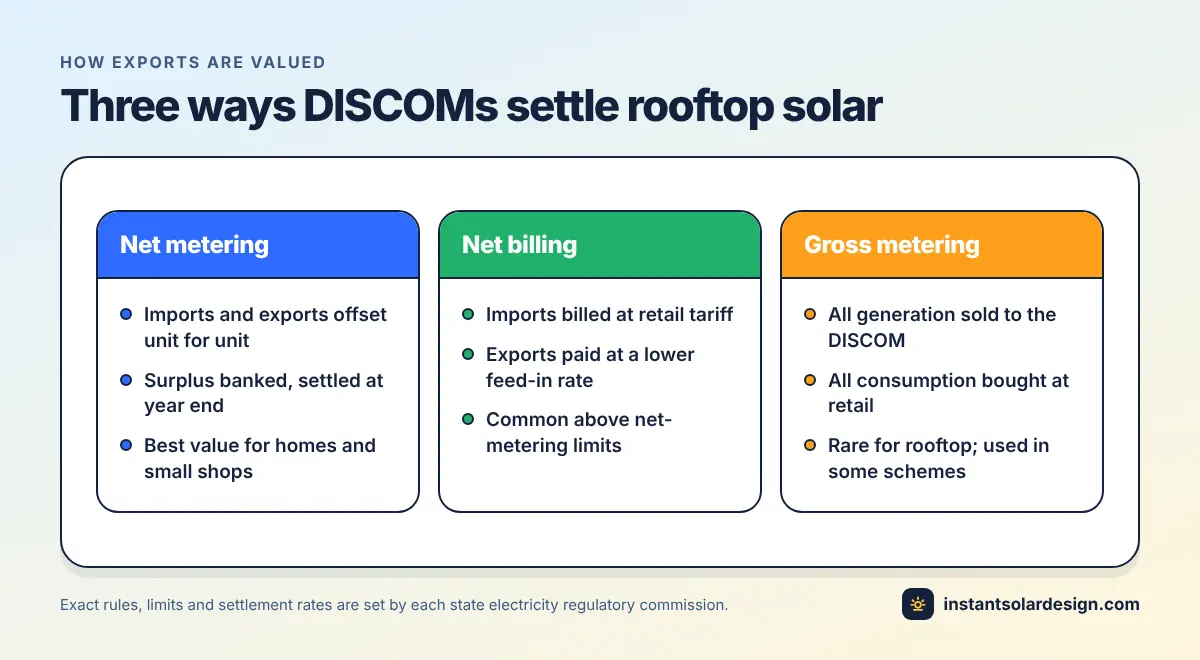
Under net metering, a bidirectional meter records imports and exports, and the DISCOM bills you only for the difference. A unit exported at noon cancels a unit imported at night. If you export more than you import in a billing cycle, the surplus is usually carried forward, and any balance at the end of the settlement year is paid out at a rate set by the state regulator — usually much lower than the retail tariff.
For a customer, net metering is the most valuable arrangement because every exported unit is worth a full retail unit, up to the amount they import. It is the default for most homes and small commercial connections.
Net billing (net feed-in)
Under net billing, imports and exports are measured separately and priced differently. Imports are billed at your normal tariff. Exports are credited at a feed-in tariff — often similar to what the DISCOM pays for power from other sources. The credit is set against the bill in money, not units.
Because the export rate is lower than the import rate, net billing rewards systems designed for self-consumption. Sizing to match daytime load, shifting loads into solar hours and adding storage all become more valuable.
Gross metering
Under gross metering, everything the system generates is exported and paid for at a feed-in tariff, and everything the building uses is bought from the DISCOM at its normal tariff. It suits investors who want a simple sale of power, and it appears in some government and community schemes, but it is rarely the best option for a homeowner because it values all generation — including what could have been used on site — at the lower rate.
What the national rules say
Settlement rules are framed by the Electricity (Rights of Consumers) Rules, 2020, and their amendments, and then implemented through regulations of each State Electricity Regulatory Commission (SERC).
- The original December 2020 rules limited net metering to systems below 10 kW, which the industry strongly opposed.
- The 2021 amendment allowed net metering for loads up to 500 kW or up to the sanctioned load, whichever is lower, where state regulations do not already provide otherwise. Above that, net billing or gross metering applies.
- The rules also allow commissions to introduce time-of-day tariffs that encourage storage.
- A draft amendment published in March 2026 proposes letting state regulators set net-metering and net-billing arrangements, with the 500 kW default where they have not. Check whether it has been notified before relying on it.
In practice, your state regulator’s rooftop solar regulations are what your DISCOM follows. Limits, banking periods, settlement rates and application timelines differ between states, so always read the current state regulation, not a national summary.
How the choice changes a bill: an example
Take an illustrative home with a 5 kW system in a month where it generates 600 units and the household uses 500 units. Suppose 240 units are used directly as they are generated, 360 units are exported and 260 units are imported at night. Assume a retail tariff of ₹8 per unit and a feed-in rate of ₹3 per unit.
- No solar: 500 units × ₹8 = ₹4,000.
- Gross metering: buy 500 units at ₹8 = ₹4,000, sell 600 units at ₹3 = ₹1,800 credit. Net ₹2,200.
- Net billing: self-use saves 240 units. Import 260 units × ₹8 = ₹2,080, export credit 360 × ₹3 = ₹1,080. Net ₹1,000.
- Net metering: imports 260 and exports 360 offset unit for unit. No energy charges; 100 units are carried forward.
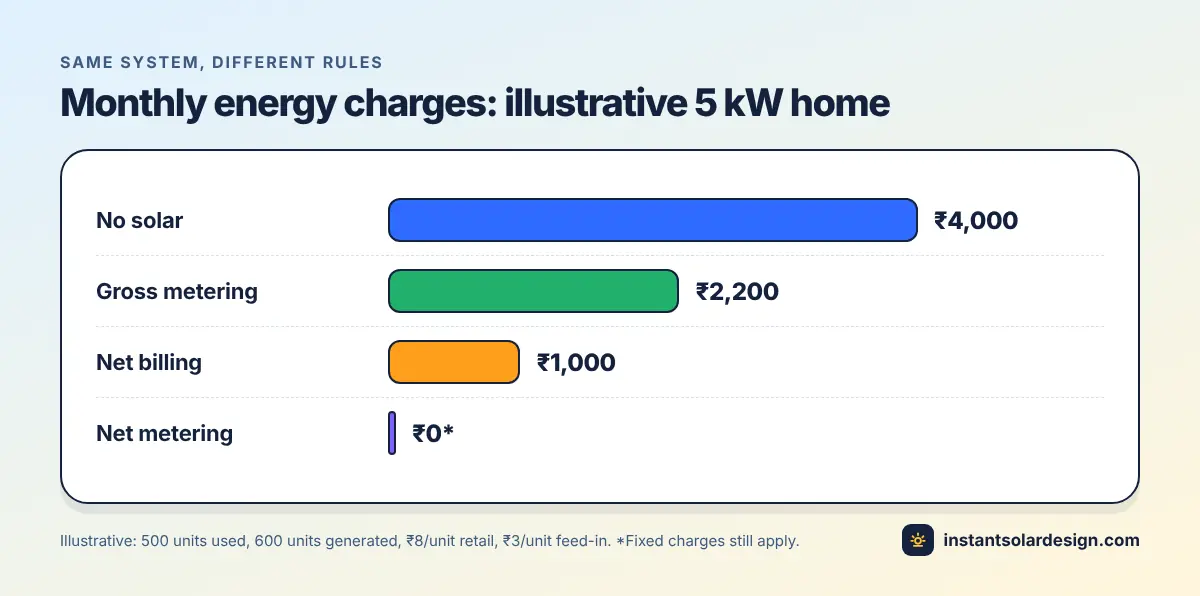
Real bills also include fixed charges, taxes and duties, and many states use slab tariffs, so the numbers will differ. The point of the example is the gap: under net billing, a system sized to generate much more than the building uses during the day earns less than it would under net metering.
How time-of-day tariffs change the picture
The 2023 amendment to the consumer rules introduced time-of-day (ToD) tariffs: the tariff during solar hours must be at least 20% lower than the normal tariff, and for commercial and industrial consumers the peak tariff must be at least 1.2 times normal. ToD applies where smart meters are installed, starting with larger commercial and industrial users.
For a solar customer, ToD has two effects. Daytime units that solar replaces become cheaper, so the value of self-use falls a little. Evening units become more expensive, so anything that moves solar energy into the evening — load shifting or batteries — becomes more valuable. Under net billing with ToD, sizing and storage decisions deserve careful modelling. We cover storage economics in rooftop solar with battery storage.
Applying for a net meter: the usual steps
The process differs by DISCOM, but most follow this pattern:
- Application: submitted online through the DISCOM portal or, for PM Surya Ghar, through the national portal, with the consumer number and proposed capacity.
- Technical feasibility: the DISCOM checks the capacity against the sanctioned load and the local transformer’s capacity.
- Installation: by an empanelled or registered vendor, using compliant modules and inverters.
- Agreement and documents: net-metering agreement, test reports, structure and earthing details, and photographs.
- Inspection and meter installation: the DISCOM inspects the system and installs the bidirectional meter.
- Commissioning: the commissioning report starts billing under the new arrangement and, for subsidised homes, triggers the subsidy claim.
Delays at steps 2 and 5 are the most common complaints. Keep a simple tracker by DISCOM office, and follow up early. Our rooftop design checklist covers the documents inspectors usually ask for.
Designing for each model
Under net metering
Size the system to cover annual consumption within the sanctioned load and roof space. Over-sizing produces surplus units that are settled at a low rate at year end, so aim close to 100% of annual use, not more.
Under net billing
Size for self-consumption. Study the daytime load profile, especially for shops, offices and factories. A slightly smaller system with a high self-use share often pays back faster than a large one that exports heavily.
Under gross metering
Maximise generation per rupee, because every unit is sold at the same rate. Orientation, tilt and shading losses matter most. A proper shadow analysis is worth doing before committing to a layout.
Common net-metering mistakes
Most disputes about rooftop savings come from a handful of avoidable errors:
- Promising a zero bill. Even with net metering, fixed charges, meter rent, taxes and duties remain. Tell customers what will be left on the bill.
- Ignoring the sanctioned load. Many DISCOMs limit system size to the sanctioned load. If the customer needs a bigger system, the load enhancement has to be applied for first, which takes time and may cost money.
- Over-sizing for “future use”. Surplus units settled at year end earn far less than units used on site. Size for current consumption unless the customer has a firm plan, such as an electric vehicle.
- Forgetting seasonal patterns. Summer air-conditioning and winter generation dips change the monthly balance. Banked units from sunny months cover cloudy ones only within the settlement period your state allows.
- Not checking the transformer. In dense areas, the local distribution transformer may already host many rooftop systems. Feasibility can be refused or limited, so ask early.
Questions to ask before quoting
- Which settlement model applies to this consumer category and size in this state?
- What is the sanctioned load, and does the system fit within it?
- What is the settlement rate for surplus units at year end?
- Is the customer on, or about to move to, a time-of-day tariff?
- How long is the DISCOM currently taking to install net meters in this area?
Rules summarised here are as reported up to November 2026. Settlement models, limits and rates are set by each state commission and change from time to time; confirm with your DISCOM before quoting.
Size it right for the tariff
Get a layout and generation estimate before you quote.
We model the roof, shadows and expected generation so you can size for net metering or self-consumption with confidence — from ₹500 per project.
Order a design →Frequently asked questions
What is the difference between net metering and net billing?
Net metering offsets exported and imported units one for one. Net billing prices them separately: imports at the retail tariff and exports at a lower feed-in rate, so exported units are worth less.
Up to what capacity is net metering allowed in India?
The 2021 amendment to the consumer rules allows net metering for loads up to 500 kW or the sanctioned load, whichever is lower, where state regulations do not provide otherwise. States set the details.
What happens to surplus units under net metering?
Surplus units are usually carried forward and settled at the end of the settlement period at a rate fixed by the state regulator, which is typically lower than the retail tariff.
Is gross metering good for homes?
Usually not. Gross metering sells all generation at the feed-in rate, including power the home could have used directly, so homeowners normally save more under net metering.
How do time-of-day tariffs affect rooftop solar?
Solar-hour tariffs must be at least 20% below normal and C&I peak tariffs at least 1.2 times normal. Solar offsets cheaper daytime units, while shifting energy to the evening through load shifting or batteries becomes more valuable.
Sources
- Down To Earth — How will India’s new net metering norms play out
- SolarQuarter — Ministry of Power approves net metering up to 500 kW
- pv magazine India — Revisiting the net metering cap for rooftop solar
- PIB — Ministry of Power on time-of-day tariffs
- Mercom — Consumers to pay 20% lower tariff during solar hours