Solar Market · · Updated · 9 min read
ALMM List-II Explained: The Solar Cell Rules Indian EPCs Must Follow in 2026
For years, “ALMM-approved” meant one thing to an installer: the module on the invoice had to come from a manufacturer on the approved list. Since 1 June 2026 that is no longer enough. ALMM List-II now covers the solar cells inside the module, and it changes how you buy, how you price and how you plan commissioning dates.

This guide explains what List-II is, which projects it applies to, the exemption deadlines that matter for rooftop and open-access work, and the practical steps that keep a project compliant without wrecking your margin.
What ALMM is, in one paragraph
The Approved List of Models and Manufacturers (ALMM) is maintained by the Ministry of New and Renewable Energy (MNRE). Only products on the list can be used in projects that the ALMM order covers. The list has two parts:
- List-I covers solar PV modules. It has applied to covered projects since 2021.
- List-II covers solar PV cells. It became effective on 1 June 2026.
In practice, a covered project now needs a module that is on List-I and is built with cells from a manufacturer on List-II. Because the cell makers on List-II are Indian factories, List-II works much like a domestic-content rule for cells.
Why the government introduced List-II
India built module assembly capacity far faster than cell capacity. Mercom reported about 261.7 GW of annual module capacity against only 36.6 GW of cell capacity in June 2026. Modules assembled from imported cells kept the value-added part of manufacturing outside the country. List-II is meant to pull investment into cell lines by guaranteeing them a protected market — the same logic that List-I applied to modules earlier.
The side effect, at least in the short run, is tight supply. When demand for List-II cells exceeds what Indian factories can produce, modules built with them carry a premium, and lead times stretch.
Which projects List-II applies to
The reported position after MNRE’s orders and clarifications in mid-2026 is:
Already in force
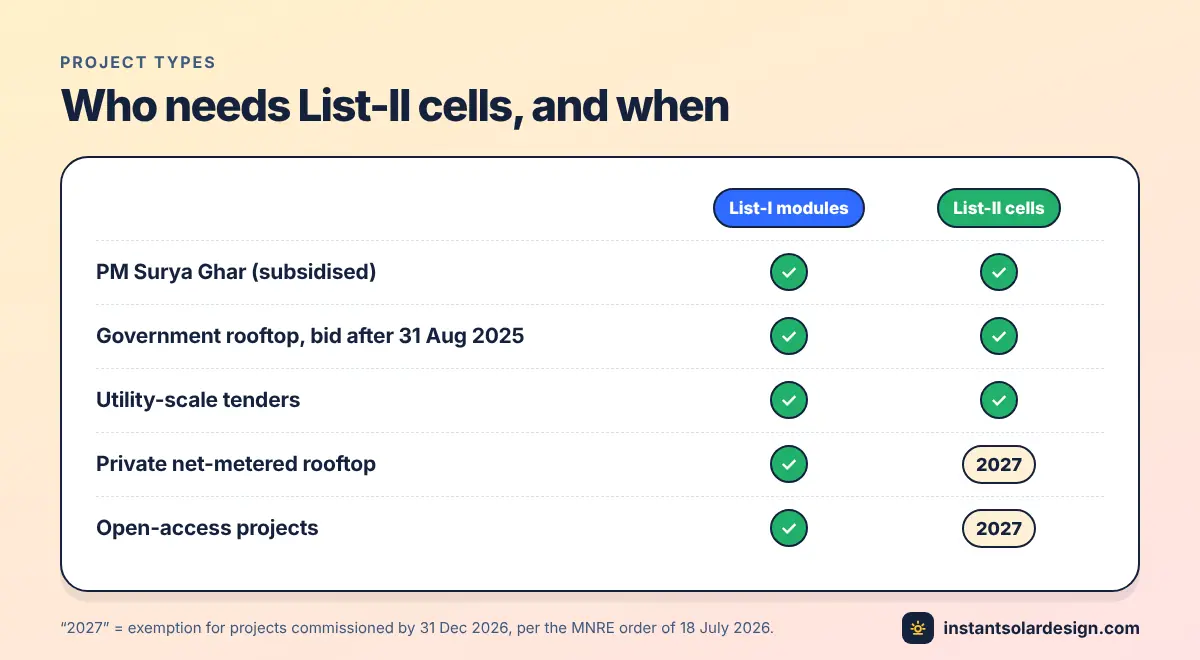
- Utility-scale and government-linked projects: List-II has applied since 1 June 2026.
- Subsidised schemes: projects under schemes such as PM Surya Ghar already require domestic content, so List-II-compliant cells are needed.
- Government rooftop projects: an office memorandum of 6 July 2026 said any rooftop project whose last date for bid submission fell after 31 August 2025 must fully comply. Bids due between 28 July and 31 August 2025 were exempted.
Exempt until the end of 2026
- Net-metering projects and open-access projects: an MNRE order dated 18 July 2026 allowed these to be commissioned without List-II cells until 31 December 2026. From 1 January 2027, List-II cells are expected to be required.
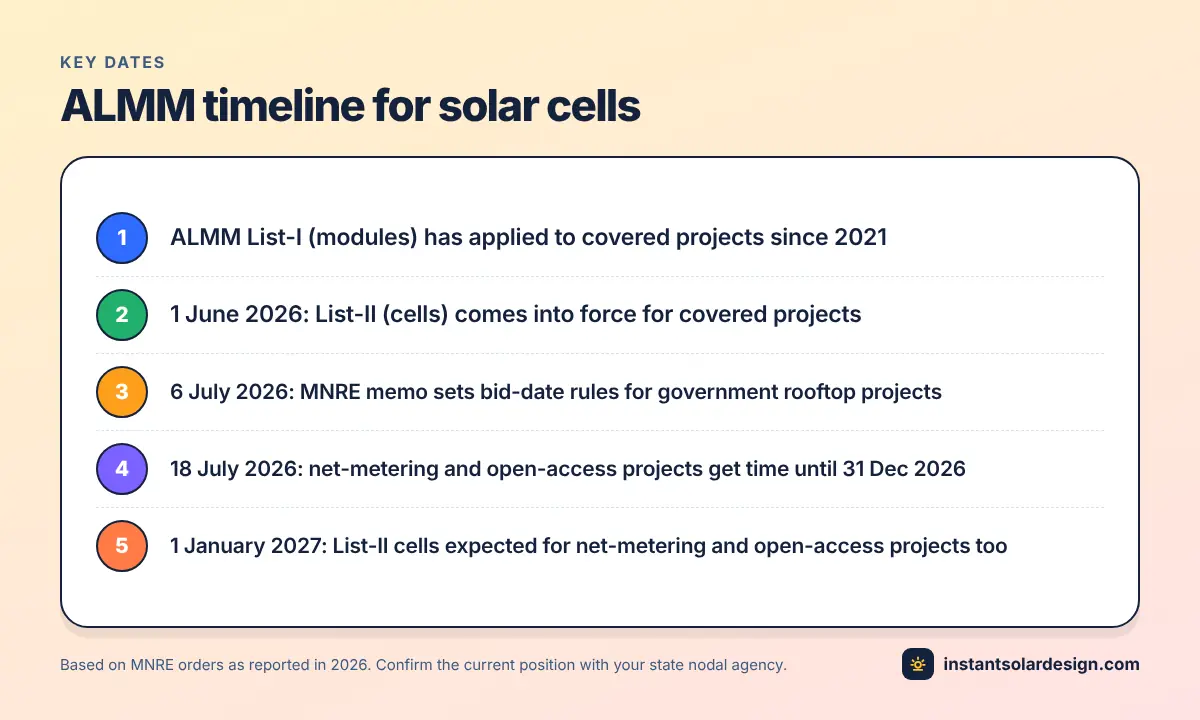
Note what the exemption is tied to: commissioning, not the purchase date or the agreement date. A private rooftop job signed in November but stuck waiting for a net meter until January could fall on the wrong side of the line. Some reports also mention a one-time relief for projects whose modules were fully installed before 1 June 2026 but whose commissioning was delayed by the DISCOM. Because the wording differs between sources, confirm any such relief with your state nodal agency before relying on it.
What List-II means for your costs
For subsidised residential work, not much changes in principle — you were already buying modules with domestic cells for PM Surya Ghar. What changes is the competition for those modules. More project types now need the same limited pool of Indian cells, so supply can tighten.
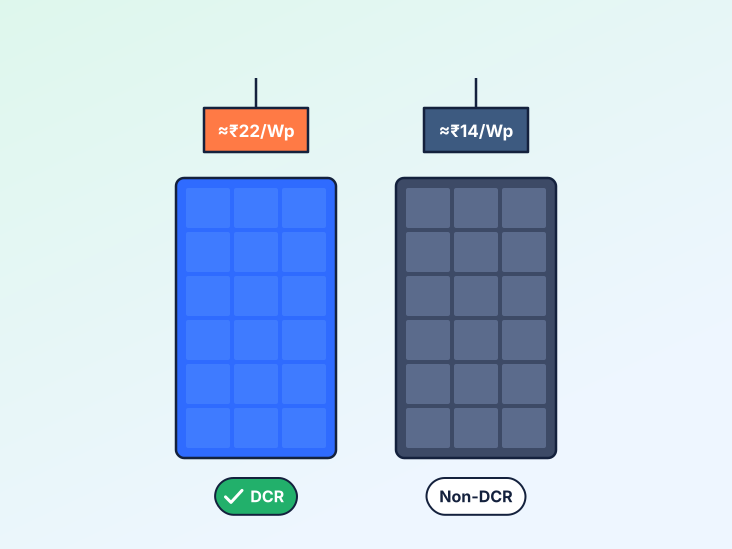
For private net-metered and open-access projects, the change is bigger. Until the end of 2026 you can still use modules with imported cells (as long as the module is on List-I). After that, the same project will likely need List-II cells. Reported 2026 bulk prices show the size of that jump: around ₹14 per watt-peak for non-DCR TOPCon modules against around ₹22 for DCR TOPCon. On a 100 kW C&I rooftop, a gap of ₹8 per watt is ₹8 lakh on modules alone.
That gap is expected to narrow as new Indian cell lines start production, but nobody can promise when. Plan your 2027 pricing around a range, not a single number. Our comparison of DCR and non-DCR panels goes deeper into prices and where each is required.
A worked example: one factory roof, two possible dates
Imagine a 50 kW net-metered rooftop for a small factory, signed in October 2026. The installer can buy a List-I TOPCon module with imported cells today, or wait for a module with List-II cells.
- If the project is commissioned by 31 December 2026, the exemption allows the module with imported cells. At the reported 2026 bulk price of around ₹14 per watt-peak, modules cost roughly ₹7 lakh.
- If commissioning slips into January 2027, the project is expected to need List-II cells. At around ₹22 per watt-peak, the same modules cost roughly ₹11 lakh — about ₹4 lakh more.
The installer cannot control the DISCOM’s net-meter timeline. So the practical choices are to build in enough time to commission comfortably before the deadline, to price the job with List-II cells from the start, or to agree in writing that the customer pays the difference if commissioning moves into 2027. All three are reasonable; the expensive mistake is not choosing.
How to check that a project is compliant
Compliance problems usually show up at inspection or subsidy release, when they are expensive to fix. A simple routine prevents most of them:
- Check the module model on List-I. Match the exact model number and wattage on the datasheet to the current list on the MNRE website, not to the brand name.
- Ask the supplier which cell manufacturer was used. Get it in writing, with the cell maker’s name as it appears on List-II.
- Collect the paperwork with the delivery. For domestic-content projects this usually means the manufacturer’s DCR certificate and the module serial numbers. Keep copies in the project file.
- Verify serial numbers before installation. For PM Surya Ghar, the portal checks module details. Mismatches found after installation can hold up subsidy for weeks.
- Record the commissioning date. For net-metered and open-access projects, the 31 December 2026 date matters. Keep the net-meter installation report and commissioning certificate.
Protecting your quotes during the transition
The months around a rule change are when installers lose money. A few contract habits help:
- Short price validity. Quote prices valid for 15–30 days and say so clearly.
- A module clause. State the module technology and compliance (for example, “ALMM List-I module with List-II cells” or “List-I module, cells as per exemption”) so the customer knows what they are buying.
- A regulatory-change clause. If the rules change before commissioning — for example, if a private project slips past 31 December 2026 — the contract should say who pays any extra cost.
- Realistic timelines. Ask your DISCOM office for its current net-metering turnaround and build it into the schedule. If a job cannot realistically be commissioned before the deadline, price it with List-II cells from the start.
How List-II changes buying decisions
Many Indian cell lines started with Mono PERC technology, while most new capacity is TOPCon. Mercom’s June 2026 data showed TOPCon at around 80% of ALMM-listed module capacity, but domestic cell supply has lagged behind. That means the module you would choose on performance alone may not always be available with List-II cells. When it is not, compare the actual generation and price per kWh, not just the label. We compare the technologies in TOPCon vs Mono PERC vs HJT.
It also pays to qualify a second supplier. If your main supplier’s List-II stock runs short in a busy month, a pre-approved alternative keeps projects moving.
What to tell customers
Most homeowners and business owners have never heard of ALMM. They do understand two things: that the government requires certain approved parts, and that those parts affect the subsidy and the warranty. A simple explanation works:
“For your project, the government requires panels from an approved list, made with Indian solar cells. That is why we are quoting this model. It keeps your subsidy and net-meter approval safe.”
For private projects being commissioned close to the deadline, be honest about the risk. Customers accept a clause about rule changes much more easily when you explain it before they sign.
Looking ahead
List-II is part of a longer push to build a full solar supply chain in India — cells today, and possibly wafers and polysilicon later. For EPCs the lesson is the same each time: rules that start with government projects tend to spread to private projects within a year or two. Keeping your bill of materials and paperwork compliant by default is cheaper than reacting to each new deadline.
This article summarises MNRE orders and clarifications as reported up to November 2026. It is not legal advice. Check the current ALMM lists and orders on the MNRE website, and confirm project-specific questions with your state nodal agency or DISCOM.
Need a compliant design pack?
Layouts and BOMs that match the module you can actually buy.
Send us the site and the module model. We return a 3D design, shadow analysis and generation report from ₹500 per project.
Order a design →Frequently asked questions
What is ALMM List-II?
ALMM List-II is MNRE’s approved list of solar PV cell manufacturers. Since 1 June 2026, projects covered by the ALMM order must use cells from List-II in addition to modules from List-I.
Does ALMM List-II apply to rooftop solar?
Yes for subsidised and government rooftop projects. Private net-metered rooftop projects were given until 31 December 2026 to commission without List-II cells, according to an MNRE order of 18 July 2026.
What happens if a net-metered project is commissioned after 31 December 2026?
From 1 January 2027 the exemption is expected to end, so the project would need modules with List-II cells. Plan the commissioning date, or price the job with compliant cells from the start.
How do I check if a module uses List-II cells?
Match the module model to ALMM List-I, get the cell manufacturer’s name from the supplier in writing, check it against List-II, and collect the DCR certificate and serial numbers with the delivery.
Will List-II make solar panels more expensive?
In the short term, modules with Indian cells cost more than modules with imported cells because domestic cell capacity is limited. The premium is expected to narrow as more Indian cell factories start production.