Solar Market · · Updated · 8 min read
Rooftop Solar Financing in India: Bank Loans, EMIs and Subsidy, Explained
For most Indian families, the hardest part of going solar is not the roof or the paperwork — it is the upfront cost. A 3 kW system can cost close to ₹2 lakh before subsidy, and the subsidy only arrives after the system is commissioned. Loans close that gap, and in 2026 they are easier to get than ever. But the terms vary, and installers who understand them close far more sales.

This guide explains how rooftop solar financing works in India, with examples of EMIs and savings, how the PM Surya Ghar subsidy fits in, and the options open to businesses.
Financing for homes: collateral-free loans
Under PM Surya Ghar: Muft Bijli Yojana, public-sector banks offer loans for residential rooftop systems. For systems up to 3 kW, the commonly reported terms are:
- Loan amount: up to about ₹2 lakh.
- Collateral: none required.
- Interest rate: around 7% a year is the most widely quoted figure; some public-sector banks have advertised lower rates, in the range of about 5.75–6.75%.
- Margin money: around 10% paid by the customer.
- Tenure: up to 10 years.
- Documents: some banks have said no income documents are needed for loans up to ₹2 lakh for systems up to 3 kW.
Above 3 kW, banks usually offer their regular solar or personal loan products, with interest linked to the bank’s lending rate and the borrower’s credit score. Terms change, so always check the bank’s current rate sheet.
How the subsidy fits in
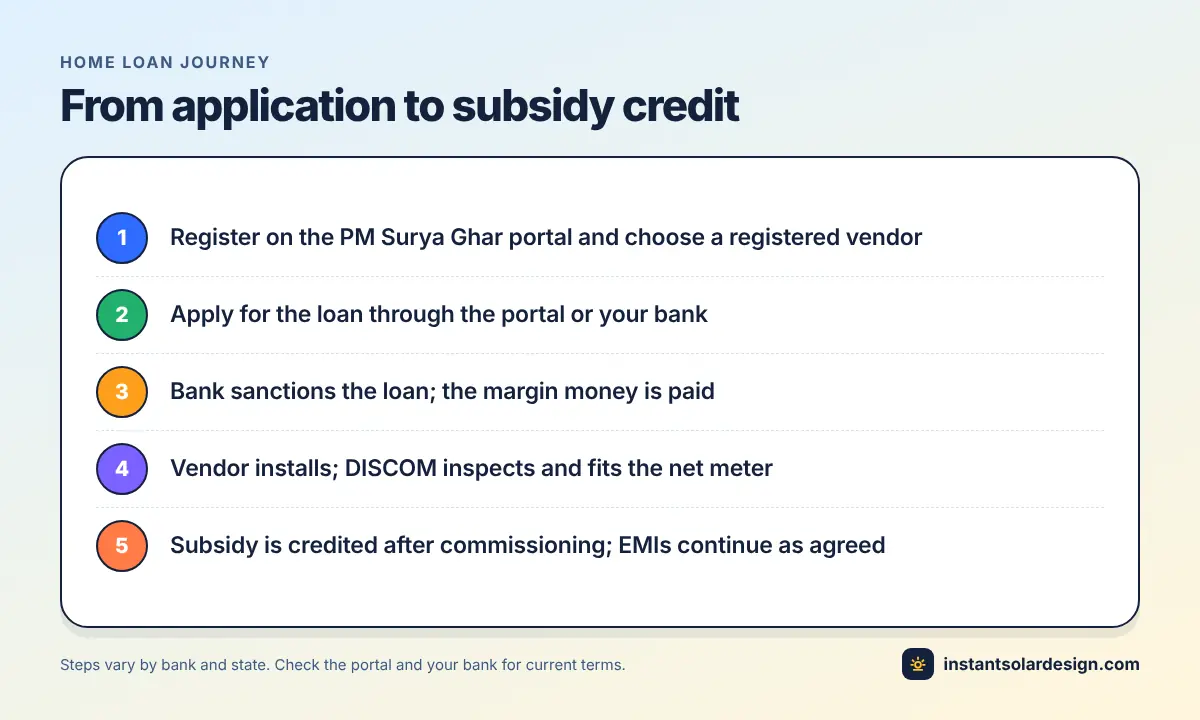
The central subsidy under PM Surya Ghar is ₹30,000 for a 1 kW system, ₹60,000 for 2 kW and ₹78,000 for 3 kW or more. It is credited to the customer’s bank account after the system is installed, inspected and commissioned — not deducted from the vendor’s invoice.
That timing matters. The customer (or the bank, through the loan) pays the full price first. The subsidy then arrives weeks later. Some customers use it to prepay part of the loan, which reduces the remaining interest. Others keep it as savings and continue the EMIs. Both are valid; make sure the customer understands the choice. Our PM Surya Ghar guide explains the subsidy rules in detail.
EMI examples
For a ₹2 lakh loan at 7% a year:
| Tenure | Monthly EMI | Total interest paid |
|---|---|---|
| 5 years (60 months) | ≈ ₹3,960 | ≈ ₹37,600 |
| 10 years (120 months) | ≈ ₹2,322 | ≈ ₹78,700 |
If the ₹78,000 subsidy is used to prepay the loan soon after commissioning, the outstanding amount drops to about ₹1.2 lakh. On a 10-year loan, keeping the same EMI then shortens the tenure significantly, and the total interest falls sharply.
Does the saving cover the EMI?
This is the question customers really ask. A 3 kW rooftop system in much of India generates roughly 12 units a day on average — about 360 units a month, though this varies by location, season, orientation and shading. If each unit replaces grid power at around ₹7, the saving is about ₹2,520 a month.
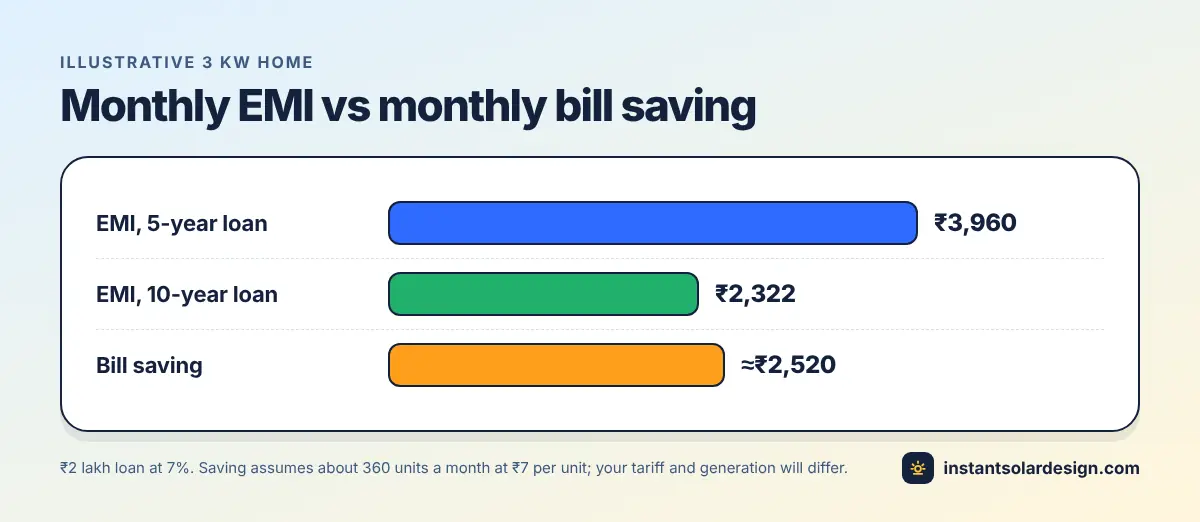
On a 10-year loan, that saving can cover the EMI from the first month in this example. On a 5-year loan, the customer pays a little extra each month but finishes much sooner. After the loan ends, almost all of the saving is the customer’s, for the remaining life of the system — usually 20 years or more.
Two cautions make this conversation honest:
- Tariff slabs: in many states, household tariffs rise in slabs. Solar usually removes the most expensive units first, which can make the saving larger — but for small consumers on low slabs, it may be smaller.
- Fixed charges stay: fixed charges, meter rent and duties remain on the bill even with solar.
A site-specific generation estimate, based on the customer’s own roof and shading, makes the EMI conversation far more convincing. See why transparent savings numbers win trust.
Calculating EMIs yourself
The standard EMI formula is:
EMI = P × r × (1 + r)n ÷ ((1 + r)n − 1)
where P is the loan amount, r is the monthly interest rate (annual rate ÷ 12) and n is the number of months. For ₹2,00,000 at 7% over 120 months, r is 0.005833 and the EMI works out to about ₹2,322. Most bank websites have calculators, but knowing the formula helps when you build your own quotation templates.
Financing for businesses
Capex with a term loan
Businesses can buy the system with a term loan from a bank or a non-banking financial company. Lenders look at the company’s financials, the project’s savings and, often, the property. Many banks offer specific products for MSMEs installing rooftop solar.
OPEX / RESCO
Under a renewable energy service company (RESCO) model, a developer installs and owns the system on the customer’s roof and sells the power at an agreed tariff for a long period, often 15–25 years. The customer pays nothing upfront. The tariff is usually below the grid tariff, so savings start immediately, though lifetime savings are lower than with ownership.
Leasing and vendor finance
Some EPCs and equipment suppliers offer leasing or deferred-payment schemes, sometimes in partnership with finance companies. These suit customers who want ownership without a bank loan, but compare the effective interest rate carefully.
Our C&I solar guide compares rooftop, open access and group captive for businesses.
Cash, loan or RESCO: a small business example
Take an illustrative shop owner considering a 20 kW rooftop system that would save about ₹2.4 lakh a year on electricity.
| Option | Upfront | Year-one cash effect | Long-term picture |
|---|---|---|---|
| Pay cash | Full system price | Full saving from month one | Highest lifetime saving |
| Bank loan | Margin money only | Saving minus EMI | High saving after the loan ends |
| RESCO / PPA | Nothing | Grid tariff minus PPA tariff | Smaller but steady saving; no maintenance |
Which is best depends on the business’s cash position, its cost of borrowing and how long it expects to stay at the site. A business planning to move within a few years may prefer RESCO or a lease with a transfer clause; a family-owned shop in its own building usually benefits most from owning the system.
Documents usually needed for a home solar loan
Requirements differ by bank, but customers are usually asked for:
- identity and address proof (for example, Aadhaar and PAN),
- a recent electricity bill in the applicant’s name or with the consumer number,
- proof of ownership of the house, or permission from the owner,
- recent bank statements, if the bank asks for them, and
- the vendor’s quotation with system details.
Getting these together before the bank visit is the simplest way to avoid delays. Installers who hand customers a one-page document list close loans noticeably faster.
How installers can make financing easy
- Know two or three banks well. Learn their documents, processing times and current rates.
- Show the EMI on the quotation next to the expected monthly saving.
- Explain the subsidy timing so customers are not surprised when they pay the full price first.
- Keep paperwork complete. Loan disbursement and subsidy release both depend on correct invoices, photos and commissioning documents.
- Follow up after commissioning to make sure the subsidy reaches the customer — it builds referrals.
Common questions from customers
“Is a loan worth it if I have the cash?”
If the loan rate is around 7% and the customer’s savings earn less than that, paying cash is usually cheaper. If they would otherwise break a higher-earning investment, a loan can make sense. It is the customer’s call; give them both numbers.
“What if I sell the house?”
The system adds value to the house and usually stays with it. Any outstanding loan has to be settled as per the bank’s terms. The net-metering agreement is transferred to the new owner through the DISCOM.
“Will the bank pay the vendor directly?”
Usually yes, in stages or on completion, depending on the bank. Clarify this before installation so the vendor’s payment schedule matches.
Loan terms and interest rates summarised here are as reported by banks and news sources up to November 2026, and they vary by bank and borrower. EMI and saving examples are illustrative. Check current terms with the bank and get a site-specific generation estimate before deciding.
Back your EMI pitch with a real design
Show the customer their own roof and generation.
We prepare 3D designs, shadow analysis and generation estimates for every quote — from ₹500 per project.
See design prices →Frequently asked questions
Can I get a loan for rooftop solar in India without collateral?
Yes. Public-sector banks offer collateral-free loans of up to about ₹2 lakh for residential systems up to 3 kW under PM Surya Ghar, with around 10% margin money.
What is the interest rate on a rooftop solar loan?
Around 7% a year is the most widely reported rate for loans up to 3 kW, with some public-sector banks advertising lower rates. Larger systems use regular loan products with rates linked to the bank’s lending rate.
What is the EMI on a ₹2 lakh solar loan?
At 7% interest, about ₹3,960 a month over 5 years or about ₹2,322 a month over 10 years.
When is the PM Surya Ghar subsidy paid?
After the system is installed, inspected and commissioned, the subsidy is credited to the customer’s bank account. It is not deducted from the vendor’s invoice.
What is the RESCO model for businesses?
A developer installs and owns the system on the customer’s roof and sells the power at an agreed tariff for a long period. The customer pays nothing upfront and saves from the first month.
Sources
- pv magazine India — Tata Power and Indian Bank partner for collateral-free rooftop loans
- Outlook Business — Tata Power Renewable Energy and Bank of Baroda financing pact
- Bank of Maharashtra — Mahabank rooftop solar panel loan
- Business Today — PM Surya Ghar: how it works and benefits
- PM Surya Ghar national portal