Solar Market · · Updated · 8 min read
PM-KUSUM in 2026: Where the Farm Solar Scheme Stands and What Comes Next
For a solar installer, a farm is a very different customer from a city rooftop: the load is a pump, the site is a field, the decision maker may be a farmer producer organisation, and the money comes largely from a government scheme. PM-KUSUM, India’s farm solar programme, has shaped that market since 2019 — and 2026 is a year of transition between its first phase and a widely expected second one.

This guide explains how PM-KUSUM works, where Phase 1 stands, what has been reported about PM-KUSUM 2.0 and how EPCs can prepare for agricultural solar work.
What PM-KUSUM is
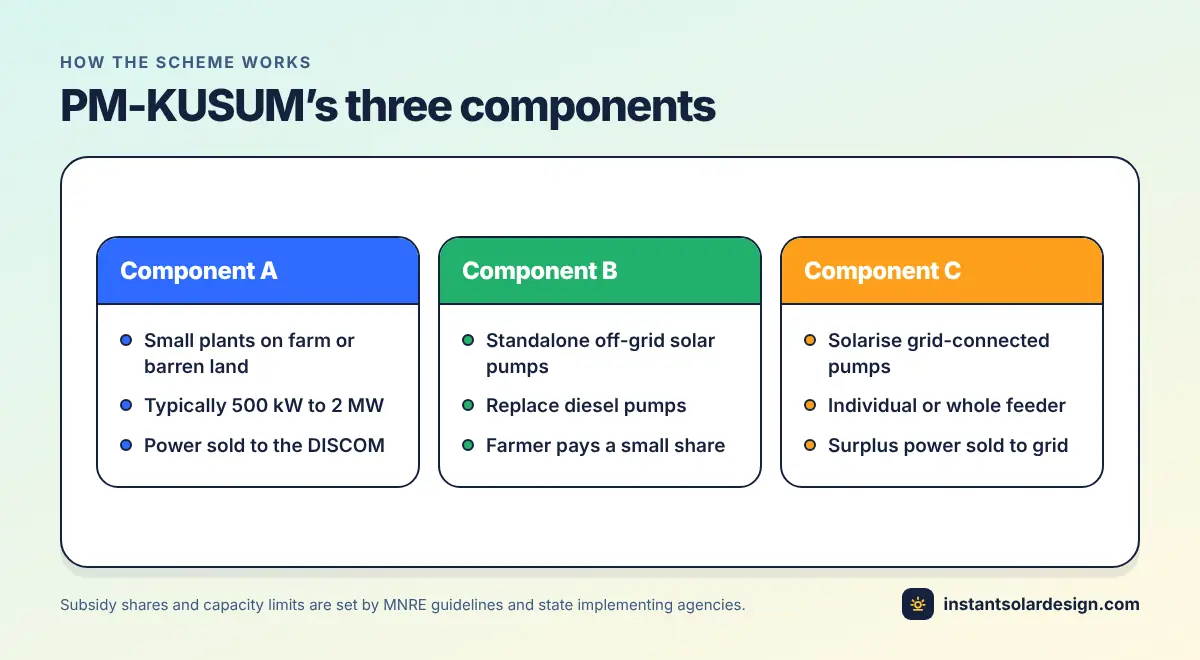
The Pradhan Mantri Kisan Urja Suraksha evam Utthaan Mahabhiyan (PM-KUSUM) aims to give farmers reliable daytime power for irrigation, cut diesel use and let farmers earn from solar generation. It is run by MNRE through state implementing agencies, usually the state nodal agency for renewable energy or the DISCOM. It has three components.
Component A: decentralised plants
Small grid-connected solar plants, typically 500 kW to 2 MW, built on barren or agricultural land near substations. Farmers, cooperatives or developers set them up and sell power to the DISCOM under a long-term agreement.
Component B: standalone solar pumps
Off-grid solar pumps that replace diesel pumps in areas without a grid connection. Central and state governments share most of the cost, and the farmer pays a smaller share, which can often be financed through a bank loan.
Component C: solarising grid-connected pumps
Existing grid-connected agricultural pumps are given solar panels, either individually or through solarisation of a whole agricultural feeder. Farmers or the feeder operator can sell surplus power to the DISCOM.
Where Phase 1 stands
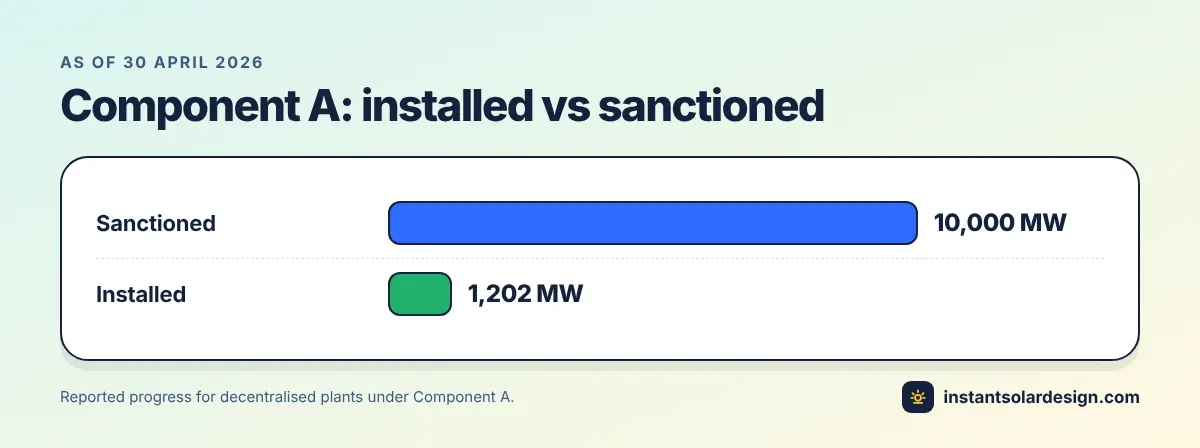
Progress has varied widely by component and state. For Component A, reported figures show about 1,202 MW installed against 10,000 MW sanctioned as of 30 April 2026 — a reminder that land, financing and grid connection are harder than the scheme design suggested.
Financing was a recurring problem. Banks were reluctant to lend for projects whose scheme deadline was approaching. MNRE extended the deadline to 31 March 2027 for projects that had a power purchase agreement or notice to proceed issued on or before 31 December 2025, with other cases considered individually. In August 2026, the Union Minister was reported as saying that Phase 1 is closed to new allocations and that a second phase may follow soon.
The budget continued: the government allocated ₹5,000 crore for KUSUM in FY 2026–27, maintaining the enhanced level from the revised estimates of the previous year.
What is known about PM-KUSUM 2.0
As of late October 2026, a second phase had not been formally launched or approved by the Cabinet, according to industry reports. Reports about its likely design mention:
- an outlay of roughly ₹50,000 crore,
- a component of about 10 GW for agrivoltaics — solar installed above or between crops, and
- battery storage integrated with feeder-level solar, to supply power into the evening.
None of this is final until the scheme is notified. EPCs should treat it as a direction of travel rather than a set of rules, and watch MNRE announcements closely.
The GST cut helped pumps directly
When GST on renewable energy devices fell from 12% to 5% in September 2025, the government estimated that a 5 HP solar pump costing about ₹2.5 lakh would become cheaper by nearly ₹17,500. For a scheme in which the farmer pays a share of the cost, that is a meaningful reduction. See our GST guide for how the rate applies.
Domestic content and quality rules
Agricultural solar under PM-KUSUM uses domestically manufactured solar cells and modules, and pumps and controllers must meet the technical specifications set by MNRE and the implementing agency. Installers are usually empanelled through state tenders, and installations often require remote monitoring and a multi-year maintenance commitment. Read DCR vs non-DCR panels for how to source and verify DCR modules.
Designing agricultural solar well
Pump sizing
Size from the water requirement, not the motor nameplate: total dynamic head (static lift plus friction losses), required daily discharge, and the crop’s seasonal demand. Over-sized pumps waste money; under-sized pumps fail at the worst time of year.
Array design
Ground-mounted arrays on farms face dust, cattle, flooding and theft. Fencing, raised mounting, proper earthing and easy cleaning access matter as much as the module choice. Shading from trees and nearby structures should be checked with the same care as on a rooftop — see our shading guide.
Agrivoltaics
If agrivoltaics becomes part of the next phase, design changes significantly: higher mounting, wider row spacing, and layouts that leave room for farm machinery and light for crops. Bifacial modules can be useful on elevated structures. The trade-off between energy yield and crop yield needs careful modelling for each site.
Feeder-level solarisation
Plants that supply an agricultural feeder must match the feeder’s load and the substation’s capacity. Grid studies, protection settings and coordination with the DISCOM are part of the job.
A simple pump-sizing example
Suppose a farmer needs about 50,000 litres of water a day from a borewell with a total dynamic head of 40 metres, including friction losses.
- The hydraulic energy needed is mass × gravity × head: 50,000 kg × 9.81 × 40 m ≈ 19.6 MJ, or about 5.5 kWh a day.
- A solar pump set (pump, motor and controller together) might convert around 40% of the electrical energy into water energy, so it needs roughly 13.6 kWh of solar electricity a day.
- If the array yields about 4.5 kWh per kWp per day after controller and temperature losses, the array needs to be around 3 kWp.
The real design must use the pump manufacturer’s performance curves, the lowest water level in the dry season and the scheme’s technical specification for array size per pump rating. But even a rough calculation like this catches the most common mistake: choosing a pump by horsepower without checking the head and daily water need.
Problems we see in field installations
- Wrong head assumptions: water tables fall in summer, increasing the head just when irrigation demand peaks.
- Dust and bird droppings: farm sites are dusty; without regular cleaning, output drops noticeably.
- Theft and damage: unfenced arrays lose modules and cables; cattle damage low structures.
- Monitoring gaps: remote monitoring units with failed SIMs or power supplies leave faults unnoticed.
- Poor handover: farmers who are not shown how to operate and clean the system call for service far more often.
Business considerations for EPCs
- Cash flow: scheme payments arrive in stages, often after inspection. Price in the working capital you will need.
- Empanelment: most work comes through state tenders with specific eligibility rules. Keep documents, past project records and certifications ready.
- Service network: pumps in remote villages need maintenance. A small local service presence is often what separates profitable agricultural work from loss-making work.
- Farmer communication: explain clearly what the farmer pays, what the government pays, the warranty and who to call when something fails.
- Farmer producer organisations: FPOs and cooperatives can aggregate demand and own Component A plants, making them important partners.
How to prepare for the next phase
- Follow MNRE and your state nodal agency for the notification of PM-KUSUM 2.0 and the state-level tenders that follow.
- Build ground-mount and pump-design capability now, including pump curves, head calculations and remote monitoring.
- Line up DCR module and pump suppliers who can deliver in volume.
- Talk to local banks about financing farmer contributions.
- Identify FPOs and landowners near substations who may be interested in decentralised plants.
What this means for the wider market
PM-KUSUM matters beyond agriculture. Feeder-level solar reduces the cost for DISCOMs of supplying subsidised farm power, which can improve their finances and, indirectly, their ability to process rooftop and open-access applications. Agrivoltaics, if it scales, would open a new category of ground-mounted projects close to rural load centres. And the scheme’s domestic-content requirement adds to demand for Indian cells — one reason the Indian solar market keeps investing in cell capacity.
Scheme details summarised here are as reported up to November 2026. Subsidy shares, eligibility and deadlines are set by MNRE guidelines and state agencies and can change; check the official PM-KUSUM portal and your state nodal agency before bidding.
Ground-mount and farm projects
Layouts and generation reports for ground-mounted solar.
We prepare 3D layouts, shadow analysis and generation estimates for ground-mounted and rooftop projects — from ₹500 per project.
Order a design →Frequently asked questions
What is PM-KUSUM?
A central government scheme run by MNRE through state agencies that funds farm solar: small plants on agricultural or barren land (Component A), standalone solar pumps (Component B) and solarisation of grid-connected pumps and feeders (Component C).
Is PM-KUSUM still open in 2026?
Phase 1 deadlines were extended to 31 March 2027 for projects with a PPA or notice to proceed issued by 31 December 2025. In August 2026 the Union Minister was reported as saying Phase 1 is closed and a second phase may follow.
What is PM-KUSUM 2.0?
An expected second phase. Industry reports mention an outlay of about ₹50,000 crore, an agrivoltaics component of around 10 GW and battery storage with feeder solar, but it had not been formally launched as of late October 2026.
How much did the GST cut reduce solar pump prices?
The government estimated that a 5 HP solar pump costing about ₹2.5 lakh would become cheaper by nearly ₹17,500 after GST on renewable energy devices fell to 5%.
Do PM-KUSUM projects need DCR modules?
Yes. Agricultural solar under the scheme uses domestically manufactured cells and modules, along with pumps and controllers meeting MNRE specifications.